

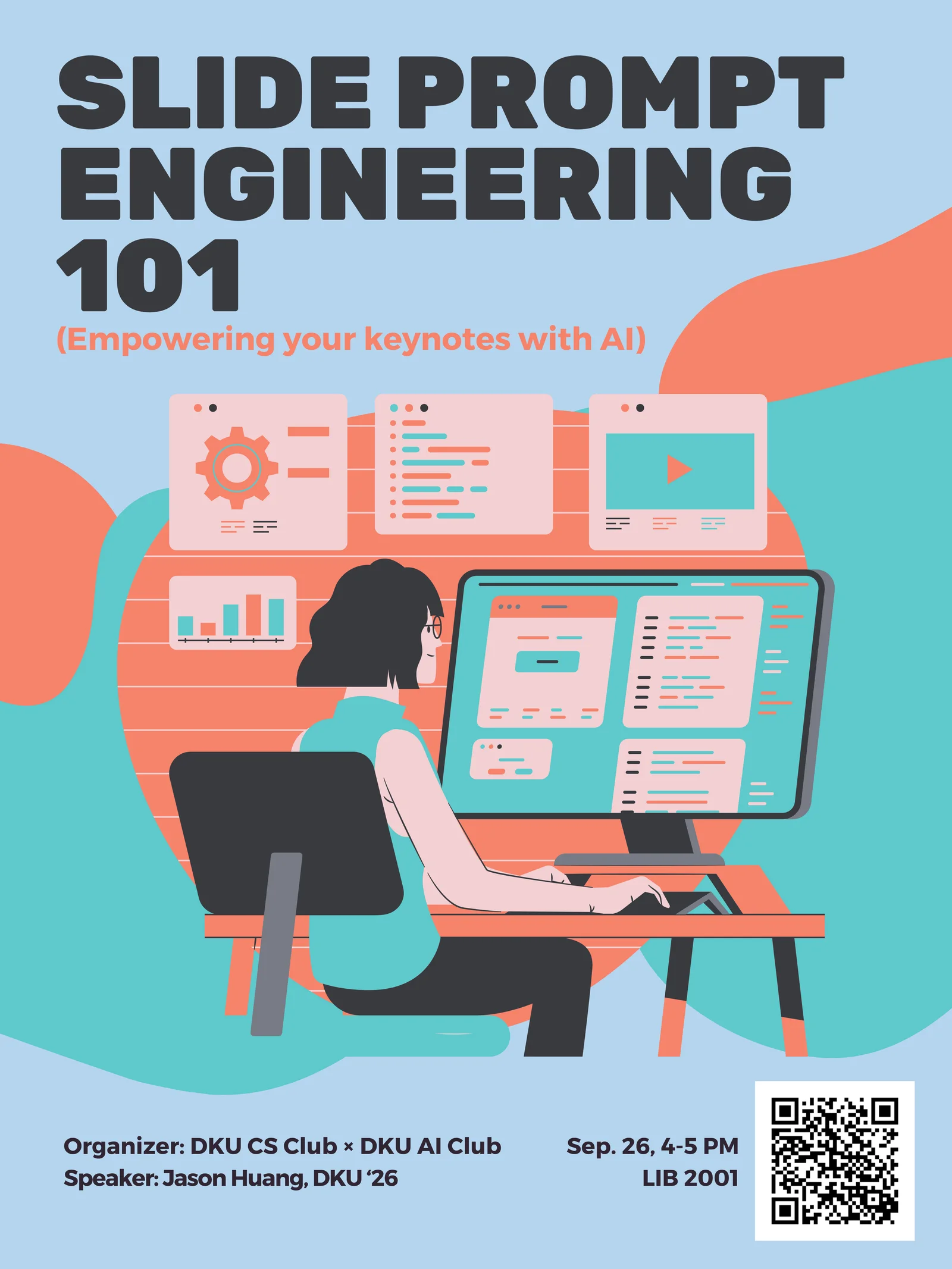
On September 26, 2025, the DKU Computer Science Club and DKU AI Club co-hosted Slide Prompt Engineering 101 in LIB 2001. Led by Jason Huang, DKU ’26, the workshop explored how students can use AI to support presentation development without giving up control over the story they want to tell.
Start With the Message, Not the Tool
The workshop treated a strong presentation as a communication problem before it becomes a design problem. Before asking an AI system to generate slides, students need to define the audience, objective, central argument, required evidence, and desired action.
A vague request such as “make a presentation about AI” gives a model little direction. A stronger prompt identifies the context, assigns a role, describes the audience, provides source material, sets a slide limit, and specifies the purpose of each section.
Prompting for Structure
Participants worked through the logic of turning an idea into a presentation outline. Useful prompts can ask an AI system to propose a narrative arc, identify missing evidence, compare alternative structures, or compress a complex topic into a limited number of slides.
This process is most effective when it is iterative. Instead of accepting a complete deck in one step, creators can review the outline, revise the argument, generate slide-level content, and then refine visual direction. Each round should have a clear evaluation question: Is the point understandable? Is the evidence credible? Does every slide advance the story?
Keeping a Human in the Loop
The session also emphasized the limits of AI-generated presentation content. Models can invent facts, produce generic language, overfill slides, and create visual consistency without conceptual clarity. Students remain responsible for checking sources, correcting errors, protecting sensitive information, and deciding what belongs in the final deck.
AI is most useful as a collaborator for brainstorming, reorganizing, editing, and exploring options. The presenter still owns the argument, the evidence, and the final delivery.
By focusing on structured prompting and deliberate review, the workshop gave participants a reusable workflow for class presentations, project pitches, research talks, and club events. The goal was not to create more slides faster, but to use AI to make the thinking behind each slide clearer.