

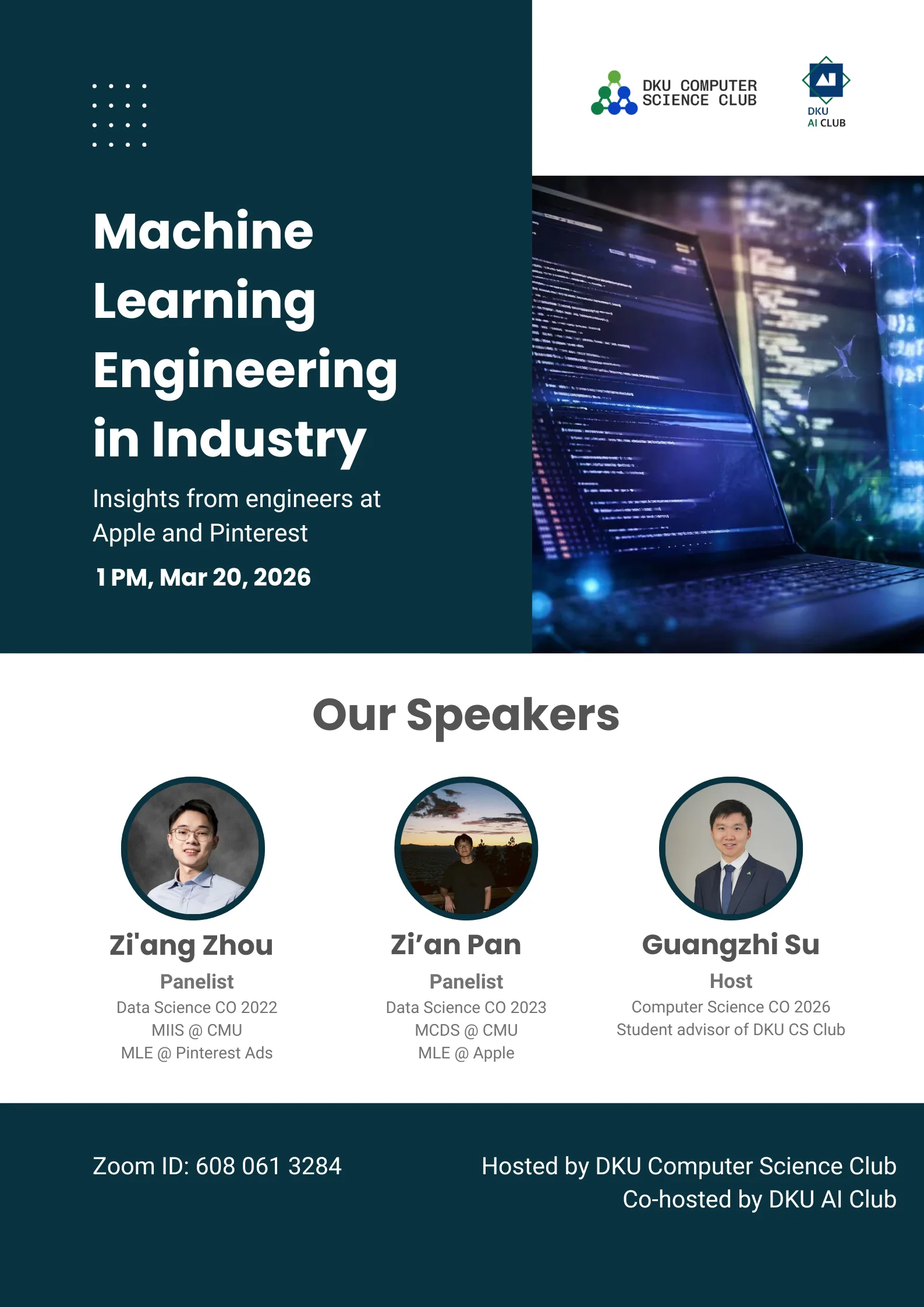
On March 20, 2026, the DKU Computer Science Club, co-hosted by the DKU AI Club, held an online panel on Machine Learning Engineering in Industry. The event welcomed DKU alumni Zian Pan, a Machine Learning Engineer at Apple, and Ziang Zhou, a Machine Learning Engineer working with Pinterest Ads.
Hosted by Guangzhi Su and organized by Yichen Wu, the conversation gave students a candid view of the path from DKU to graduate study at Carnegie Mellon University and then into machine-learning roles at major technology companies.
What an MLE Actually Does
The panel began by distinguishing machine-learning engineers from neighboring roles such as data scientists, software engineers, and ML researchers. While the boundaries vary across teams, an MLE often works at the intersection of modeling and production engineering: preparing data, developing and evaluating models, building reliable pipelines, monitoring systems, and collaborating with product and infrastructure teams.
The speakers discussed how a typical week may be divided among coding, experimentation, data work, technical design, debugging, meetings, and cross-functional communication. This helped move the role beyond the simplified image of “training models” and toward the reality of maintaining systems that must perform reliably for real users.
From DKU to Graduate School and Industry
Drawing on their own experiences, the panelists reflected on the choices that shaped their careers. Research and internships helped them discover which problems they enjoyed, while graduate study offered deeper technical training and access to larger engineering projects.
Their journeys also showed that there is no single required sequence. Students can use courses, labs, internships, independent projects, and team competitions to test different interests before committing to a specialization.
Building Evidence, Not Just a Résumé
For students interested in MLE careers, the speakers emphasized a combination of fundamentals and practice. Mathematics, algorithms, systems, and core machine-learning concepts provide the base, but projects and internships reveal whether a student can apply those ideas under real constraints.
The discussion encouraged students to build work they can explain in depth: what problem they chose, why a method was appropriate, what failed, how performance was evaluated, and what they would improve next. In interviews, that depth of ownership can be more valuable than a long list of tools.
Engineering in the AI Era
The panel closed by considering how AI-assisted development is changing engineering work. Tools can accelerate coding and experimentation, but they also make judgment, system design, verification, and communication more important. Future MLEs will need to learn new tools quickly without losing the ability to reason about data quality, model behavior, infrastructure, and user impact.
We thank Zian Pan and Ziang Zhou for returning to the DKU community and sharing their experiences with openness and generosity. The session gave students a more realistic picture of machine-learning engineering—and a clearer set of next steps for exploring the field.