

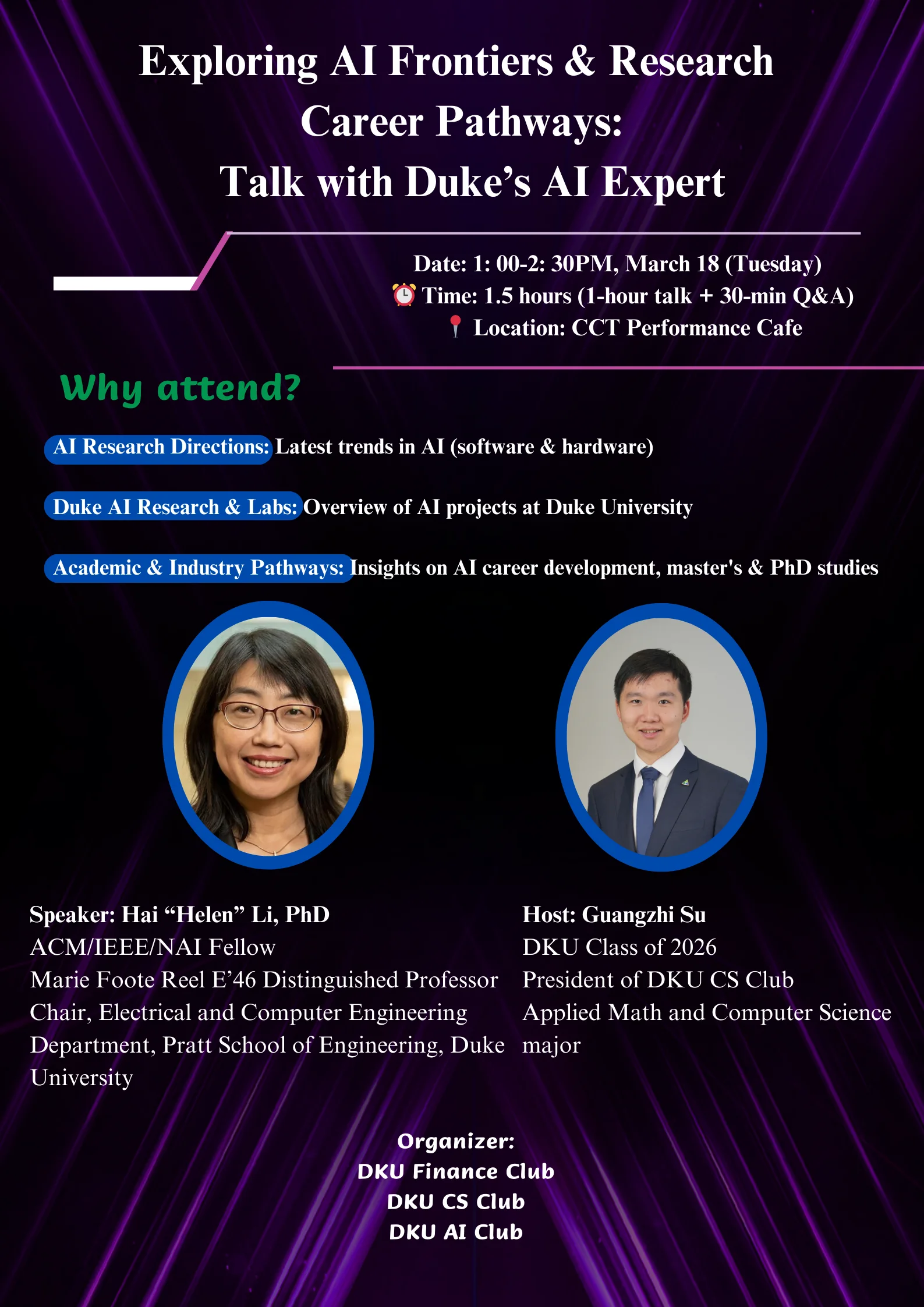
On March 18, 2025, the DKU Computer Science Club, DKU AI Club, and DKU Finance Club welcomed Professor Hai “Helen” Li to the CCT Performance Cafe for a conversation connecting frontier AI research with the choices students make at the beginning of an academic career.
Professor Li, Chair of Duke University’s Department of Electrical and Computer Engineering, framed the session around a central challenge: how can increasingly powerful foundation models become efficient, private, and safe enough to serve people beyond large cloud data centers?
Why Large Models Need Better Guardrails
The technical portion of the talk began with the data behind large language models. Because these systems learn from enormous collections of text, they may memorize sensitive or copyrighted material and reproduce it in later interactions. Professor Li introduced research directions for detecting training-data leakage, reducing the exposure of personally identifiable information, and protecting models against attacks that unfold across multiple turns of a conversation.
The discussion made privacy and safety feel like engineering requirements rather than optional additions. Building a useful AI system means considering not only what a model can generate, but also what information it retains, how it may be prompted, and how its behavior changes in a real deployment environment.
Bringing Foundation Models to the Edge
The second part of the talk moved from model safety to computational efficiency. Running large models on phones, embedded systems, local servers, or other edge devices introduces strict limits on memory, energy, and processing power. Professor Li presented approaches including model compression, low-precision computation, specialized hardware acceleration, and efficient transformer architectures.
Students also learned how on-device personalization could make AI systems more useful in areas such as healthcare and education while keeping private data closer to the user. The session introduced parameter-efficient fine-tuning, LoRA, and federated black-box prompt tuning as ways to adapt models without repeatedly retraining every parameter or transferring an entire model between devices.
The talk’s long-term vision was captured in a simple phrase: “Big AI, Small Devices.” The future of AI should not depend only on building larger systems; it should also make advanced capabilities more accessible, energy-efficient, and human-centered.
Seeing Research as a Pathway
Beyond the technical material, Professor Li introduced the breadth of AI and computing research at Duke, from trustworthy computing and edge systems to hardware, machine learning, and interdisciplinary applications. Her perspective helped students see how software, algorithms, computer architecture, and responsible deployment fit into the same research ecosystem.
The final Q&A connected these topics to undergraduate preparation, graduate study, and research careers. Students were encouraged to strengthen their fundamentals, remain open to work across traditional disciplinary boundaries, and look for problems whose impact extends beyond a benchmark score.
For the organizing clubs, the session demonstrated the value of bringing active researchers directly into the student community. It gave attendees both a view of where AI is heading and a clearer sense of how they might participate in shaping that future.