

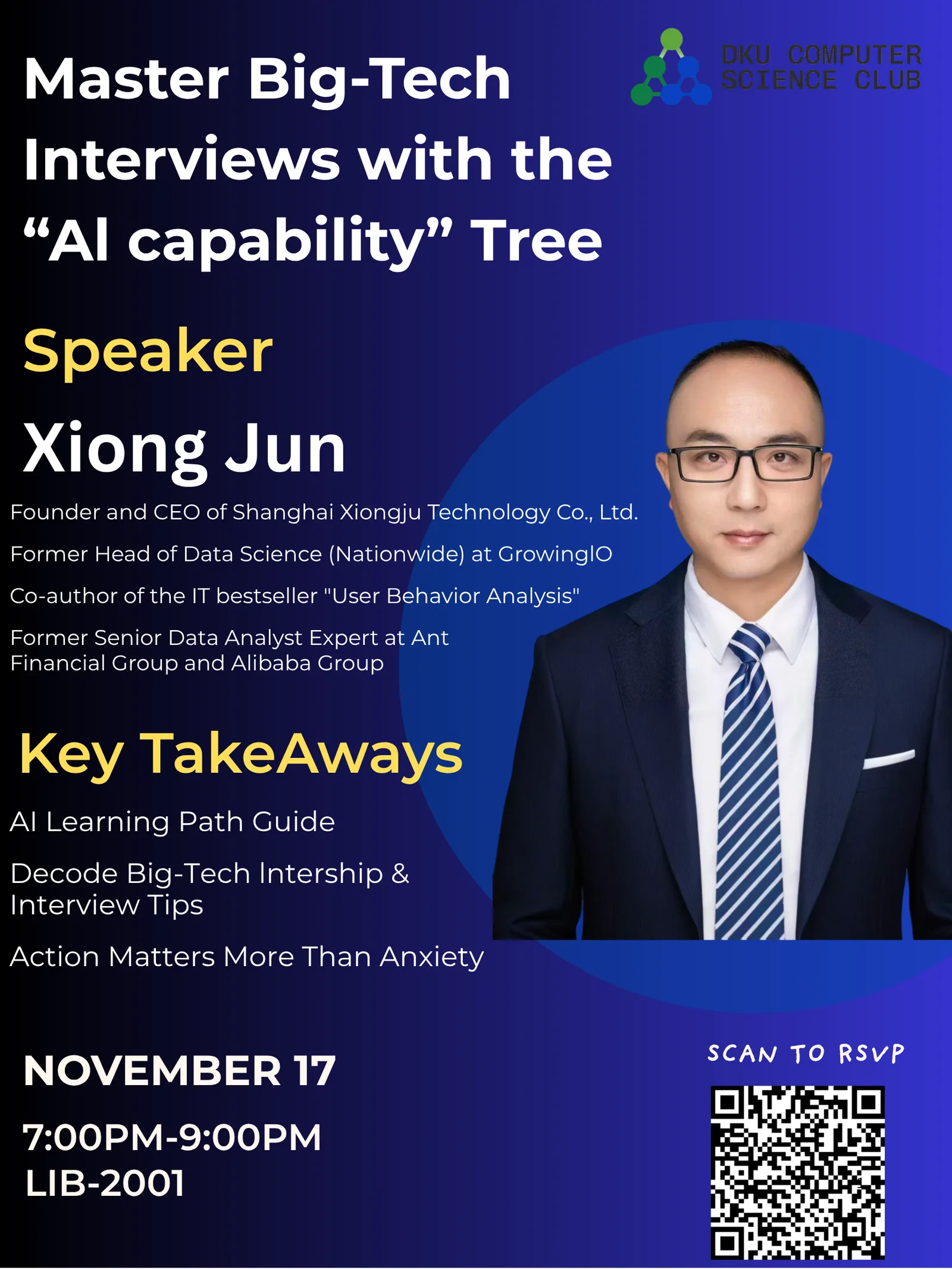
On November 17, 2025, the DKU Computer Science Club hosted Xiong Jun in LIB 2001 for an evening lecture on building the knowledge, project experience, and analytical habits needed for data and AI careers.
Xiong Jun brought experience from Alibaba Group, Ant Financial, and GrowingIO, as well as his perspective as the founder and CEO of Shanghai Xiongju Technology. Rather than presenting interview preparation as a list of isolated questions, he organized the session around an “AI capability tree”: a connected set of foundations that students can develop over time.
Understanding the System Behind the Hype
The lecture began with the development of artificial intelligence from early rule-based systems to machine learning and modern foundation models. Students examined the relationship among data, algorithms, and computing power, as well as the practical limits created by data quality, privacy, copyright, model scale, and the cost of computation.
This broader history provided context for current AI tools. Models may change quickly, but the ability to understand data, define an objective, evaluate a result, and recognize an unreliable assumption remains transferable.
From Algorithms to Business Decisions
The session then connected technical methods with enterprise decision-making. Examples from user growth, financial technology, and risk analysis showed how a data project moves from a business question to measurable indicators, model selection, experimentation, and interpretation.
Participants were introduced to common machine-learning ideas and the reasoning behind data-driven projects. The emphasis was not on memorizing every algorithm. Instead, students were encouraged to understand what problem a method solves, what evidence supports its result, and how that result changes a real decision.
Preparing for Technical Interviews
The final section translated the capability tree into an action plan for internships, graduate study, and campus recruitment. Strong candidates combine several forms of evidence:
- solid computer science, mathematics, and statistics fundamentals;
- projects that show ownership from problem definition to evaluation;
- research, internships, open-source work, or other sustained practice;
- the ability to explain technical choices clearly;
- structured estimation and problem-solving under uncertainty.
The lecture also used Fermi-style estimation to demonstrate how interview candidates can decompose an unfamiliar question, make reasonable assumptions, calculate an approximate answer, and then test whether that answer makes sense.
One takeaway from the evening was especially direct: action matters more than anxiety. Students do not need to master the entire AI landscape before beginning. They need to choose a direction, build consistently, reflect on their work, and turn each project into clearer evidence of what they can do.
The event gave attendees a practical map for moving from interest in AI to deliberate preparation—and for approaching interviews as a test of connected thinking rather than short-term memorization.